lunes, 16 de abril de 2012

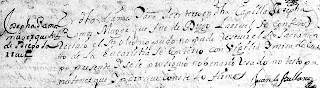
[Genealogia SLP] 1579 defunción de Doña Josepha Flores de Abrego En dicho dia mes y año se enterro en dicha Capilla Josepha Ramos Muger que fue de Diego Larruel se confeso recibio el Sto. Oleo no pudo no pudo resevir el Sto. Sacramento de la Eucharistia se enterro con vig

---------- Mensaje reenviado ----------
De: Ricardo Raúl Palmerín Cordero <duardos43@hotmail.com>
Fecha: 16 de abril de 2012 08:39
Asunto: DEFUNCIONES DE DOÑA JOSEPHA Y DON DIEGO.1710 Y 1725.

 
Envío los registros de defunción de Doña Josepha Flores de Abrego ( Ramos ) primera esposa de Don Diego Laruel (Laurel)
 y madre de mis antepasados, pues don Diego Contrajo segundas nupcias con Doña Juana de Quintanilla.
 
Fuentes. Family Search. Iglesia de Jesucristo de los Santos de los últimos Días.
 
LIBRO DE DEFUNCIONES DE LA YGLESIA PARROQUIAL DE MONTERREY, AÑOS DE 1710 Y 1725.
 
Datos del registro de defunción anterior:  Doña Maria Munguia, esposa que fué de Juan de Chapa,  por la fecha y lugar 23 de Marzo de 1710 Capilla de San Francisco que no se citan en el de Doña Josepha.
 
Márgen izq. Josepha Ramos muger que fué de Diego Larruel. 
 
En dicho dia mes y año se enterro en dicha Capilla Josepha Ramos Muger que fue de Diego Larruel  se confeso recibio el Sto. Oleo no pudo no pudo resevir el Sto. Sacramento de la Eucharistia se enterro con vigilia y misa de cuerpo presente y se le prosiguio nobenario resado no testo por no tener que y para que conste lo firme.  Juan de Arellano.
 
Márgen izq. Diego Laruel Fernz. esposo que fue de Da. Juana de Quintanilla.
 
En 13 de Abril de 1725 as. en la Parroquial de Monte Rei enterré á D. Diego Laruel Fernz. esposo que fué de Da. Juana de Quintanilla recivio todos los Sacramentos de eucharistia  vigilia y missa de cuerpo presente se le siguio nobenario resado lo que mando en su testamento como tambien dxa. a cada una de las mandas forsosas  y otros para la ------- del ---Gregorio Lopez es su albacea Joseph Cavazos y para que conste lo firme. Juan de Arellano.
 
Investigó y paleografió.
Tte. Cor. Ricardo Raúl Palmerín Cordero


--
Has recibido este mensaje porque estás suscrito a Grupo "Genealogia de San Luis Potosi" de Grupos de Google.
Si quieres publicar en este grupo, envía un mensaje de correo
electrónico a genealogia-slp@googlegroups.com
Para anular la suscripción a este grupo, envía un mensaje a genealogia-slp-unsubscribe@googlegroups.com
Para obtener más opciones, visita este grupo en http://groups.google.com.mx/group/genealogia-slp?hl=es.
 
Los miembros de la Sociedad Genealógica Potosina se comunican gratuitamente entre si usando equipos de Voz sobre IP de http://www.tusip.com

domingo, 15 de abril de 2012

[Genealogia SLP] 1578 DOS DEFUNCIONES CD. DE MÉXICO. AÑOS DE 1855 Y 1857.


---------- Mensaje reenviado ----------
De: Ricardo Raúl Palmerín Cordero <duardos43@hotmail.com>
Fecha: 14 de abril de 2012 14:52
Asunto: DOS DEFUNCIONES CD. DE MÉXICO. AÑOS DE 1855 Y 1857.


Hola amigas y amigos.
 
Envío dos registros de defunción acaecidos en la Cd. de México,D.F. los años de 1855 y 1857.
 
El primero corresponde al Sr. Gral. Don Casimiro Liceaga y dice lo siguiente:-
 
Márgen izq. 758  El S. Gral. D. Casimiro Liceaga, Casado de 63 años.
 
En ocho del mes de Mayo de mil ochocientos cincuenta y cinco, se le dió sepultura Ecca. en el Panteon de los Angeles al cadaver del Sor. Gral. D. Casimiro Liceaga Dor. en Medicina, y Caballero de la Nacional y distinguida órden de Guadalupe casado que fué en segundas nupcias con la Sa. Da. Asuncion Estrada, el que haviendo recibido los Stos.Sacramentos murió el día 5 Calle del Hospicio No. 21.  Dr. Eulogio María Cárdenas.
 
El segundo corresponde a la Sra. Doña Josefa Inzaurraga, madre del Teniente Don Juan de la Barrera quién murió en Defensa de la Patria el 13 de Septiembre de 1847.
 
Márgen izq. 55  Da. Josefa Ynzaurraga casada 55 años. Compn.
 
En veinte y dos de Enero de mil ochocientos cincuenta y siete se le dió sepultura Ecca. en el Panteon de Sta. Paula al cadaver de Da. Josefa Ynzaurraga, casada que fué con Don José de la Barrera, la que habiendo recibido los Stos. Sacramentos murió ayer Calle de Tiburcio No.12
 
Fuentes. Family Search. Iglesia de Jesucristo de los Santos de los últimos Días.
 
LIBRO DE DEFUNCIONES DEL SAGRARIO METROPOLITANO DE LA CD. DE MÉXICO.
 
Investigó y paleografió.
Tte. Cor. Ricardo Raúl Palmerín Cordero


--
Has recibido este mensaje porque estás suscrito a Grupo "Genealogia de San Luis Potosi" de Grupos de Google.
Si quieres publicar en este grupo, envía un mensaje de correo
electrónico a genealogia-slp@googlegroups.com
Para anular la suscripción a este grupo, envía un mensaje a genealogia-slp-unsubscribe@googlegroups.com
Para obtener más opciones, visita este grupo en http://groups.google.com.mx/group/genealogia-slp?hl=es.
 
Los miembros de la Sociedad Genealógica Potosina se comunican gratuitamente entre si usando equipos de Voz sobre IP de http://www.tusip.com

viernes, 13 de abril de 2012

[Genealogia SLP] 1577 Genearcas-Protagonistas en el atentado a Maceo en Costa Rica-Un enfoque genealógico.

---------- Mensaje reenviado ----------
De: Emilio Obando <emiliobando@ice.co.cr>
Fecha: 13 de abril de 2012 18:08
Asunto: Genearcas-Protagonistas en el atentado a Maceo en Costa Rica-Un enfoque genealógico.


Con sumo agrado, le invitamos a acceder y descargar del sitio WEB Genearcas, de Emilio Gerardo Obando Cairol, en https://sites.google.com/site/genearcascostarica/ , el ensayo Protagonistas en el atentado a Maceo en Costa Rica-Un enfoque genealógico.


Los sucesos o eventos que acontecen tienen espacio, tiempo y protagonistas determinados. Desde que, en las distintas culturas antiguas como la egipcia, china, griega, romana y otras, cronistas, historiadores y literatos comenzaron a  dejar constancia de acontecimientos en que fueron testigos o tuvieron referencias de ellos, hemos conocido con amplitud el lugar y la fecha en que sucedieron, pero, y en esto incluimos la época actual, suelen consignar escuetamente a sus protagonistas, como si el lector tuviera el pleno conocimiento de quien o quienes fueron ellos.

Sabía usted que:


·         El general Antonio Maceo y sus hermanos se distinguieron en la guerra de independencia por la libertad de Cuba. La casi totalidad de ellos ofrendaron su vida en alguna de las batallas que se libraron de entre 1868 y 1878, y entre 1895 y 1899. Un hijo de Maceo estudió pocos años en un instituto de Cartago.

·         Isidro Incera y Calzada, quién murió en el atentado del 10 de noviembre de 1894,  fue el fundador, junto con su sobrino Antonio Incera Calvo, de la familia Incera en Costa Rica. Conozca su descendencia.

·         Enrique Loynaz Castillo, quien ultimó a Incera, luego de que éste hirió a Maceo, tuvo un hermano, Armando, que nació en Costa Rica, y Armando, su hijo, dejó descendencia en nuestro país.


Para descargas inmediatas, recomendamos usar Google Chrome.


--
Has recibido este mensaje porque estás suscrito a Grupo "Genealogia de San Luis Potosi" de Grupos de Google.
Si quieres publicar en este grupo, envía un mensaje de correo
electrónico a genealogia-slp@googlegroups.com
Para anular la suscripción a este grupo, envía un mensaje a genealogia-slp-unsubscribe@googlegroups.com
Para obtener más opciones, visita este grupo en http://groups.google.com.mx/group/genealogia-slp?hl=es.
 
Los miembros de la Sociedad Genealógica Potosina se comunican gratuitamente entre si usando equipos de Voz sobre IP de http://www.tusip.com

[Genealogia SLP] 1576 [Genealogía de México] 30807 DEFUNCION DE DOÑA BEATRIS DE LAS CASAS. AÑO DE 1674.

---------- Mensaje reenviado ----------
De: Jose Luis Montemayor <joseluis.montemayor@gmail.com>
Fecha: 13 de abril de 2012 20:18
Asunto: Re: [Genealogía de México] 30807 DEFUNCION DE DOÑA BEATRIS DE LAS CASAS. AÑO DE 1674.
Para: genealogia-mexico@googlegroups.com


Anexo hijuela de partición practicada en 1687 por los hijos del Capitán Diego de Villarreal y Doña Beatriz de las Casas.
 
Saludos.
 
José Luis
 

Leg. No 5                                    Documento No. 29
Sello del SUPR. TRAL. DE CIRCUITO DE N. LEON, COAHUILA Y TAMAULIPAS MONTERREY
Hijuela de partición practicada en 1687 por los hijos del Capitán Diego de Villarreal y Doña Beatriz de las Casas, de los bienes raíces que en el Cañón de las Salinas (dejaron) a estos por herencia de su abuelo el Capitán Bernabé de las Casas, cuya partición fue aprobada por el Marques de San Miguel Aguayo, Don Agustín Eheveces y Suavisa, Gobernador y Capitán General del Nuevo Reino de León.
1890
Feb ……… e 1890
Señor Alcalde 1º de Abasolo Benigno Villarreal, por sí y en representación de sus coaccionistas en las Haciendas de Dolores, Ligeros y demás de las otras haciendas de la jurisdicción, ante Ud. como mejor proceda comparezco exponiendo: que siendo conveniente y necesario a mi derecho y al de mis representados hacer uso de la hijuela de partición que en el año 1687 se practicó por nuestros antecesores, Diego, Juan Bautista, Bernabé, Juan y Francisco de Villarreal y Doña Beatriz de las Casas cuyo documento existe en el archivo de su cargo, a Ud. pido y suplico se sirva mandar se me de un testimonio formal del expresado título para el uso de nuestro derecho.  Juro lo necesario .. Abasolo Abril 6 de 1852 = Benigno Villarreal = Villa de Abasolo Abril de 1852 = Por presentado el anterior escrito e impuesto de su contenido como se pide, debía de mandar y mando se le de la copia autorizada del documento que en él se expresa, que se halla en el archivo de mi cargo.  Yo el C. Tomás Ozuna Alcalde 1º Suplente de dicha Villa por este auto así lo decreto, mando y firmo, actuando con testigos de asistencia, doy fe = Tomás Ozuna = De asistencia = Mariano Sánchez = De asistencia = Francisco González ==
En la Ciudad de Nuestra Señora de Monterrey y Nuevo Reino de León en treinta días del mes de Junio de mil seiscientos ochenta y siete años ante el Sr. D. Agustín Echevesas y Suavisa, Marquez de San Miguel de Aguayo, Caballero de la orden de Santiago, Gobernador y Capitán General de este dicho Reino y sus conquistas por su Majestad la presentaron los contenidos los Capitanes Diego, Juan Bautista y Bernabé, Juan de Villarreal, Francisco y Cristóbal Villarreal vecinos del Valle y Real de las Salinas de esta Gobernación como hijos legítimos del Capitán Diego de Villarreal y Doña Beatriz de las Casas y sus herederos, como consta del testamento bajo cuya disposición fallecieron nuestros padres, que para en el archivo de este juzgado a que nos remitimos.
Ante Usía parecemos en la mas bastante forma que haya lugar en derecho y decimos que por haber quedado bienes raíces de dichos nuestros padres como son sitios y caballerías de tierras y partes de mismas que están por indiviso y porque tenemos convenido entre todos el partir dichos bienes hermanablemente sin litigio y ¿? en lo de adelante, hemos determinado hacer dicha partición hermanablemente atento a lo cual a Usía pedimos y suplicamos se sirva de concedernos licencia para hacer dicha partición en la mas bastante forma que llevamos referida que fecha estamos prontos a traerla ante Usía para que sea servido de confirmarla y de ella poner en autoridad y decreto judicial que en hacerlo así recibiremos bien y merced con justicia que pedimos y firmamos a Dios y a la señal de la Santa Cruz este nuestro escrito no ser de malicia y lo más necesario = Diego de Villarreal =Juan de Villarreal = Juan Bautista de Villarreal = Bernabé de Villarreal = Cristóbal de Villarreal = Francisco de Villarreal == Que visto por su Señoría dijo: que atento a que le han confirmado de buena unión y concordia en hacer la partición que refieren les concedía y concedió  licencia para ella que lo hagan de la mejor forma que les convenga nombrando para ello la persona o personas que quieran para el mejor acierto de ella y su igualación en las porciones que les pueda tocar o por víd de aprecio o en especie según como son los dichos bienes o según o de la manera que se avinieren y fecha de dicha partición parecerán ante su Señoría a presentarla para la aprobación y las demás diligencias que para su firmeza y perpetuidad se requieren y así lo proveyó y firmó con dos testigos de asistencia por no haber en este Reino Escribano público ni real = El Marqués de San Miguel de Aguayo = Testigo = Diego Esaenz = Testigo Don Pedro Echeves ------------------------------------------------------------------------
En el Real y Valle de las Salinas en cinco días del mes de Julio de mil seiscientos y ochenta y siete años.  Estando en la hacienda que llaman de la Magdalena que es la cabecera de dicho real Nos los Capitanes Diego, Juan, Juan Bautista, Bernabé, Francisco y Cristóbal de Villarreal vecinos del dicho Valle en conformidad de la licencia de partición que está en esta foja  a la vuelta del Sr. Don Agustín de Echeveses y Suavisa, Marqués de San Miguel de Aguayo, Caballero de la orden de Santiago, Gobernador y Capitán General de este Nuevo Reino de León y sus conquistas por su Majestad decimos que como hijos y herederos legítimos que somos del Capitán Diego de Villarreal y Doña Beatriz de las Casas, vecinos y pobladores de dicho real, que fallecieron debajo de disposición de testamento cuyos bienes y herencia tenemos adquiridos y aceptados con beneficio de inventario y de nuevo los aceptamos todos mayores de veinticinco años y aunque por dicho testamento quedaron algunos bienes muebles que constan en dicho inventario a causa de haberse seguido al fallecimiento de dicho nuestro padre las guerras de los indios del Norte de que es frontera este Real y en particular se continuaron en los principios del Gobierno de Don Nicolás Ascárraga que lo fue de este Reino por los años de seiscientos setenta en adelante en cuyo tiempo los dichos indios dieron en dicho Real con grandísimo resto de más personas , mujeres e hijos, que muchos salimos flechados, habiéndose convocado con los indios levantados los de dicha hacienda como le consta a dicho Señor Marqués de San Miguel, pues los bajó de paz siendo Teniente General del Reino de Vizcaya circunvecino a este con cuyo accidente los indios destruyeron y se llevaron las caballadas, muladas y demás bienes muebles que había en dicha hacienda como también entró a la jurisdicción de él con lo cual dicho Don Nicolás de Ascárraga mandó por su mandamiento se retiraran todos los vecinos a la Ciudad de Monterrey con que quedó despoblado y todos los bienes muebles de dicha hacienda, destruidos no quedando más que tan solamente en ella los sitios y caballerías, que le pertenecen por títulos, mercedes y compras y otros derechos y dichas tierras e inexpugnables montes como es público y notorio en este Reino con que habiéndose aquietado en alguna manera la guerra nos volvimos a dicho Real con riesgo de nuestras personas y para poder sustentar nuestras familias nos obligó a elegir en dichas tierras baldías diferentes partes a donde con grandísimo riesgo y abriendo algunos pedazos de tierra por haber hallado este medio por el más eficaz instrumento y así para sustentarnos con las semillas de dichas tierras como para defender dicho Real con cuya vecindad a nuestro ejemplo los hicieron otros muchos como fueron los herederos del Capitán Antonio Treviño por el beneficio de las minas y así mismo aumentó este Reino por estar dicho Real frontero del Norte motiváronos también a la elección de dichos parajes y a ejemplar de nuestro tío Marcos de las Casas heredero de la tercera parte de dichas tierras por la parte materna de nuestro abuelo el Capitán Bernabé de las Casas que por la parte que le pudo tocar al dicho nuestro tío Marcos de las Casas abrió mas labores con saca de agua en el río de las Salinas en que sembró maíz y tuvo cría sembrando dicho puesto antes que nosotros más de veinte años que es el que al presente tienen sus herederos llamándolo comúnmente el puesto Marcos de las Casas que es la parte donde hoy se hallan los paredones de las casas de dicho puesto y los que nosotros hermanablemente y de común consentimiento hemos ido sembrando dentro de los límites que comprenden las medidas de las caballerías que pertenecen a dicha hacienda con parte de los sitios adjuntos, que todo se contiene en los recaudos, títulos y mercedes que pertenecen a dichos nuestros padres que son en la manera y forma siguiente.  Primeramente en la hacienda de labor que llaman "Enmedio" que es en la que sacó acequia y labró nuestro padre el Capitán Diego de Villarreal, en la cual quedan comprendidos y señalados el Capitán Juan de Villarreal y Alférez Cristóbal de Villarreal, primeramente en tierras y aguas en esta manera: que el Capitán Juan de Villarreal ha de coger por la banda del sur corriendo hacia la sierra de dicha banda por la atravesía y comenzando el lindero por la parte de abajo como dos tiros de arcabuz de la casa nueva en que vive que es un arroyo ancho de unas piedras grandes que sube a la dicha sierra del Sur y corriendo la banda de dicha Sierra hasta llegar al "Mal Paso" que es el lindero de arriba de enmedio de dichas partes ha de ser el río de las Salinas que pasa por enmedio quedando siempre enterados en tanta parte el uno como el otro en la labor referida y por lo que toca a la parte de dicho Cristóbal de Villarreal, en el lindero de abajo comenzó de la presa que llaman del Mortero que es la del Capitán Diego de Villarreal atravesando a la sierra del Norte al portezuelo que está enfrente, y en este lindero corriendo río arriba por la banda del Norte  hasta llegar al lindero ya referido del Mal Paso con lo cual quedaron enterados por lo que toca a sus tierras y aguas los susodichos, salvo la razón que en la parte de dicho Juan de Villarreal, tiene molino de fundición  Al Capitán Diego de Villarreal se le señaló para su labor desde la presa del Mortero que es la que tiene al presente comenzando desde el lindero y corriendo río abajo quedando su labor por la banda del Norte de dicho río corriendo por donde tiene su casa de vivienda y molino de fundición hasta llegar a un arroyuelo que llaman del Paso de las Moras por la parte de abajo, de allí atravesando hasta dicha Sierra del Norte con que quedó ajustado el dicho señalamiento del Alférez Francisco de Villarreal se le señaló por su labor desde el lindero de abajo del dicho Capitán Diego de Villarreal llamado de las Moras y de este lindero corriendo al dicho río de las Salinas abajo por la banda del Norte hasta llegar a un arroyo de la Cieneguilla que llaman del Chipinque que atraviesa por la banda del Norte hacia dicha Sierra, así en la parte del río, bajo dicho arroyo por una barranca de piedra tosca con que quedó ajustado en sus linderos.  El Capitán Bernabé de Villarreal se le señaló desde el lindero arriba mencionado del dicho Francisco de Villarreal llamado la Cieneguilla del Chipinque y arroyo de Portezuelo corriendo dicho río de las Salinas abajo por la banda del Norte hasta lindar con los terrenos de los herederos de Alonso Rodríguez por la banda de dicha Sierra del Norte con las aguas donde al presente tiene su galera con las demás que le pertenecen en el término de de su pertenencia como queda ajustado en sus linderos.   Al Capitán Juan Bautista de Villarreal se le señaló para su labor, desde el arroyo que llaman de Vásquez por donde baja una vereda al río por dentro del propio arroyo que es hasta donde lindan los terrenos de nuestro tío Marcos de las Casas por la parte del sur y las dichas tierras corren de la banda del Sur por la orilla de dicho río de las Salinas hasta llegar por esta parte a los ojos de agua de San Miguel, así mismo linda con la dicha sierra de San Miguel por la parte del Sur, con que los sitios que le cupieron de parte, se le han de medir conjuntos con dichos términos arriba mencionados, si los hubiere por aquella parte con que quedó ajustada, y es declaración que en cuanto a los sitios de tierras que nos pertenecen en dicho Real de las Salinas, así por título, derecho o traspaso por razón de sitios que al presente están algunos en litigio con el Capitán José de Ayala a donde están al presente acomodados por la defensa de los que nos pertenecen por cuya razón no se puede hacer partición al presente de ellas hasta vencido dicho litigio, que vencido estamos conformes y comprometidos de partirnos hermanablemente en ellos en la misma forma que lo hemos fecho en las tierras de labor, entrando en derecho y sitios partes que les tocan los herederos de nuestro tío Marcos de las Casas regulándonos primero por lo que cada uno tuviere con parte de dentro de los límites de las tierras de labor arriba señaladas y lo que faltase a cada uno se le ha de enterar en la regulación que hubiere de dichos sitios, con declaración que nuestro hermano el Capitán Diego de Villarreal ha de elegir la parte de sitio que le tocare por la banda de la sierra de las mina hacia el Norte, que es donde tiene al presente su caballada y ganado mayor, que lindan con tierras de los herederos de Antonio Rodríguez y los títulos y demás recaudos que nos pertenecen, así los de esta virtud hemos fecho la división arriba referida para labores como los demás que están pendientes en dicho litigio, han de parar en poder de dicho nuestro hermano Diego de Villarreal para que luego que estén vencidos y saque cada uno de nosotros testimonio para en guarda del derecho que le perteneciere, así mismo es declaración que por cuanto a dicho Capitán Juan de Villarreal, Cristóbal de Villarreal en las partes que les ha cabido arriba mencionadas, gozan de labor que benefició al dicho nuestro padre puso en corriente y sacó acequias por lo cual quedan los obligados de mancomún a sacar el agua de la labor señalada al dicho Francisco de Villarreal del río de dichas Salinas hasta la parte de dichas tierras donde puedan regarlas el dicho Francisco de Villarreal por haberse contentado el susodicho recibir dichas tierras eriasas con dicha condición a que quedan obligados los susodichos Juan de Villarreal y Cristóbal de Villarreal lo cual han de cumplir dentro de tres meses y con el dicho cargo se les hac la partición de sus dos partes en dicha labor de en medio en que todos hemos convenido y así mismo es declaración que en cuanto a la hacienda de fundición que llaman de la Magdalena con un tablón, cañones una aguja de fierro quifo ------ así mismo los graseros de la dicha hacienda y lo demás que pertenece a dicha hacienda con las barra de minasen la que llaman del "Rosario" quedan para que todos los referidos lo gocen en todos los herederos por iguales partes y así mismo es declaración que en cuanto a las casas de vivienda que fueron de nuestros padres que están en dicho real de las Salinas que llaman de la Magdalena, en que todos somos convenidos de nuestra voluntad que se repartan dichas casas a costa de nosotros rata por cantidad de lo que costare y después quedamos concertados sobre la dicha vivienda en los alquileres de ella, se digan misas lo que dieren así por meses o por años, quedando obligados a los reparos los que viviesen en ellas, las cuales misas que así resultaren aplicadas por las almas de nuestros padres y nuestros herederos e hijos y sucesores, por el tiempo que durasen dichas casas y así mismo nos obligamos todos juntos, rata por cantidad a aliñar dicha capilla que está en dicho Real para que se pueda celebrar el Santo Sacrificio de la Misa con alguna decencia .  Así mismo es declaración que en las deudas que resultaren de los dichos nuestros padres sobre las dichas tierras que arriba han sido mencionadas, de caballerías y sitios que nos tocasen después de regulados cada uno en la parte que le tocase en dichas tierras a las deudas, u así mismo es declaración que en la parte arriba mencionada del Capitán Juan Bautista de Villarreal, tiene puesto molino de fundición a su cuidado y su costa con licencia de la real justicia y por lo cuanto los susodichos estamos conformados y convencidos, contentos y satisfechos, hermanablemente en la forma de dicha partición con las declaraciones dispuestas a ella, según y como en cada una de ellas se contiene límites, linderos y condiciones en la parte legítima que a cada uno le pertenece con las calidades de ella, como tales hijos legítimos y herederos de los dichos nuestros padres, otorgamos esta escritura de partición por el orden y forma que en ella se declara, por lo tanto, por la presente de nuestro grado y buena voluntad estando ciertos y bien informados de nuestros derechos y lo que este caso nos conviene hacer y haciendo sobre ello de nuestro y liberación, según nos conviene habiéndonos aconsejado con personas celosas del servicio de Dios, movidos de la conciencia de nuestra justicia que nos ha asistido para evitar pleitos, litigios por lo de adelante y que no quedando a nuestros hijos para que se pueda conservar dicha hacienda sin ellos por la suma pobreza de este Reino, nos hemos convenido en la forma referida de la ya dicha partición arriba mencionada, en cuya conformidad concordia y hermanablemente la una parte de nos ala otra todos los bienes raíces que en la dicha partición han tocado y tocarán de uso incorporado y pertenencias a cada uno de nosotros como tales herederos, según y de la manera referida en dicha partición y declaraciones adjuntas, con declaración que los dichos sitios ha de entrar la parte de los herederos del dicho nuestro tío Marcos de las Casas, en la que perteneciere según sus derechos, lo cual dicha partición aprobamos y ratificamos por estar justamente hecha par que cada uno de nosotros, herederos y sucesores y las otras personas que en esta causa hubieren en cualquiera manera gocen los dichos bienes perpetuamente con todas sus entradas y salidas, derechos, costumbres y servidumbres, cuantos dichos bienes les perteneces según la dicha partición que tenemos por fecha a cada uno por lo que toca de fuero y derecho, para cuyo efecto nos cedemos, renunciamos y traspasamos las unas partes de unos en las otras  y las otras en las otras, los derechos, con derechos y acciones que a los dichos bienes tenemos y nos pertenecen como tales herederos y en ellos apoderamos a las otras y las otras a las otras para que sean nuestros propios y como tales podamos vender, trocar, donar, cambiar y enajenar y hacer de ello como cosa propia habida, adquirida con justo título y derecho y buena fe como esta lo es y nos damos y otorgamos las unas partes a las otras y las otras a las otras poder cumplido y bastante para que cada uno de nosotros pueda tomar y continuar la tenencia y posesión de dichos bienes, ampararlo, conviviendo y en el ínterin nos constituimos las partes a las otras y las otras de los otros por inquilinos, tenedores y poseedores y en señal de dicha posesión nos damos y entregamos esta escritura de partición y adjudicación para que en virtud de ella a su traslado la tomemos sin otro acto alguno de aprensión y así mismo nos hacemos gracia y donación irrevocable que el derecho llama INTERVIVOS, desde ahora para siempre las unas partes a las otras, y las otras a las otras, de la demasía que en cualquiera manera que cada uno llevase más que a lo en la dicha partición nos tenemos adjudicados dichos bienes con las insinuaciones y denunciaciones de derecho necesario por lo prescrito cada uno de nos toca y está adjudicada en la dicha partición, de tal manera que los dichos bienes o cualquiera parte de ellos nos saliere inciertos por causa legítima o por otra razón, tomaremos la voz y defensa las unas partes a favor de las otras hasta dejarlas en la quieta y pacífica posesión, siguiendo a nuestra costa y mención y donde nos obligamos de pagar la dicha parte que les saliese por cierta por su justo valor, rata por cantidad y lo mismo se ha de entender en la paga de las deudas legítimas que pareciesen de nuestros padres en razón de dichos bienes de la dicha partición que quedamos obligados cada uno , rata por cantidad en la parte que le tocase.  Y a la firmeza y cumplimiento de todo lo en esta escritura contenidos de partición con las declaraciones y condiciones adjuntas, obligaos nuestras personas y bienes habidos y por haber y damos poder z cualquier justicia de su Majestad y en especial a las de esta jurisdicción y Reino para que nos apremien a su cumplimiento por todo rigor de derecho y vía ejecutiva y como por sentencia definitiva por nosotros consentida y basada en causa juzgada renunciamos todas las leyes en nuestro favor con la general renunciación y conformidad de lo que tenemos pedido a su Señoría el Sr. Marquez de San Miguel Gobernador y Capitán General de este Reino en la partición a que fue servido concedernos licencianpara hacer dicha partición, en la forma y manera que lo hemos fecho, le pedimos y suplicamos interponga a ello su autoridad y judicial decreto, y lo firmamos de nuestros nombres hallándose presente el Sr. Licenciado Don Francisco de la Calancha, el Alférez Gerónimo Cantú y Antonio González Valdés y es declaración que la parte de dicho Juan de Villarreal tiene molino de fundición == Diego de Villarreal == Bernabe de Villarreal == Francisco de Villarreal == Juan Bautista de Villarreal == Cristobal de Villarreal == Juan de Villarreal ------------------------------------------------------------------
Que vista por dicho Señor Marqués Gobernador y Capitán General de este Reino

--
Has recibido este mensaje porque estás suscrito a Grupo "Genealogia de San Luis Potosi" de Grupos de Google.
Si quieres publicar en este grupo, envía un mensaje de correo
electrónico a genealogia-slp@googlegroups.com
Para anular la suscripción a este grupo, envía un mensaje a genealogia-slp-unsubscribe@googlegroups.com
Para obtener más opciones, visita este grupo en http://groups.google.com.mx/group/genealogia-slp?hl=es.
 
Los miembros de la Sociedad Genealógica Potosina se comunican gratuitamente entre si usando equipos de Voz sobre IP de http://www.tusip.com

[Genealogia SLP] 1575 DOÑA MARÍA GERTRUDIS BOCANEGRA MENDOZA 1765- 1817.

---------- Mensaje reenviado ----------
De: Ricardo Raúl Palmerín Cordero <duardos43@hotmail.com>
Fecha: 13 de abril de 2012 10:22
Asunto: DOÑA MARÍA GERTRUDIS BOCANEGRA MENDOZA 1765- 1817.


Para mis amigas y amigos.
 
 
Hace aprox. seis años buscando rastros de mis ancestros paternos del Estado de Michoacán, viendo los films de Pátzcuaro encontré los  registros del bautismo y defunción de Doña María Gertrudis Bocanegra Mendoza.
 
Doña María Gertrudis Bocanegra Mendoza fué una de nuestras heroínas durante la lucha de Independencia y murió siendo pasada por las armas por las tropas Realistas en la misma ciudad de su nacimiento. en esas fechas se encuentran los registros de muchos muertos los que fueron pasados por las armas y de los cuales saqué copia.
 
Fuentes. Family Search. Iglesia de Jesucristo de los Santos de los últimos Días. ( GRACIAS HERMANOS MORMONES )
 
LIBRO DE BAUTISMOS DE LA CIUDAD DE PÁTZCUARO, MICH.
 
Márgen izq. Ma. Gertrudis Theodora.  Por orden del Sr. Alcalde se sacó copia el 6 octubre de 1910.
 
En el año del Sr. de mil setecientos sesenta y cinco en onze de Abril, en la Yglecia Parroquial Mor. del Sr.Sn. Salvador de esta Ciud. de Patzquaro, el M.R.P. Predicador del Convento del Sr. Sn. Francisco, de ella Frai Nicolas de Araujo ( con licencia de mi el Cura Beneficiado). bautizo, puso Sto. Oleo y Chrisma, á una Ynfanta y por nombre Maria Gertrudis Theodora, hija legma. de Pedro Bocanegra y de Pheliziana de Mendoza, fue su padrino el Br. Dn. Domingo Ybarra Clerigo Diacono, aquien dixe su obligacion y para que conste lo firme Yo el Cura. Francisco Javier Vargas.
 
LIBRO DE DEFUNCIONES DE LA CIUDAD DE PÁTZCUARO, MICH.
 
Márgen izq. Ma. Gertrudis Bocanegra. Pasada por las armas.
 
En el año del señor de mil ochocientos dies y siete: en onse de Octubre. Habiendosele administrado los Santos Sacramentos de la Penitencia y Eucaristia, á Ma. Gertrudis Bocanegra, pasada por las armas, Española, viuda; volvió su alma á Dios N.S. y a su cuerpo se le dió Ecca. sepultura, en la Yglecia de la Compañía de esta Ciudad, en el ultimo tramo con insignias altas y doble solemne por que conste lo firmé. Pedro Rafael Conejo.
 
 
Investigó, localizó y paleografió.
 
Tte. Cor. Ricardo Raúl Palmerín Cordero

--
Has recibido este mensaje porque estás suscrito a Grupo "Genealogia de San Luis Potosi" de Grupos de Google.
Si quieres publicar en este grupo, envía un mensaje de correo
electrónico a genealogia-slp@googlegroups.com
Para anular la suscripción a este grupo, envía un mensaje a genealogia-slp-unsubscribe@googlegroups.com
Para obtener más opciones, visita este grupo en http://groups.google.com.mx/group/genealogia-slp?hl=es.
 
Los miembros de la Sociedad Genealógica Potosina se comunican gratuitamente entre si usando equipos de Voz sobre IP de http://www.tusip.com

[Genealogia SLP] 1574 MATRIMONIO DE DON DIEGO LARUEL FERNANDEZ Y DOÑA JOSEPHA FLORES. AÑO DE 1691.

---------- Mensaje reenviado ----------
De: Ricardo Raúl Palmerín Cordero <duardos43@hotmail.com>
Fecha: 13 de abril de 2012 07:29
Asunto: MATRIMONIO DE DON DIEGO LARUEL FERNANDEZ Y DOÑA JOSEPHA FLORES. AÑO DE 1691.


Hola amigas y amigos.
 
Envío el registro del matrimonio de mis ancestros Don Diego Laruel ( Laurel ) Fernández y Doña Josepha Flores.
 
Fuentes. Family Search. Iglesia de Jesucristo de los Santos de los últimos Días.


LIBRO DE MATRIMONIOS DE LA YGLESIA PARROQUIAL DE MONTERREY.
 
Márgen izq. D. Diego Laruel Fernandez y Josepha Flores.  Españoles.
 
En veinte de Agosto de mil y seiscientos y nobenta y un años case y vele a Don Diego Fernandez Laruel y Josepha Flores Españoles  aviendo precedido las vanas en tres, doze y quinse de dho. mes y año fueron testigos Joseph Saens, Juan de la Vera y Pedro Montalbo y para que conste lo firme Vt Supra= Joseph Guajardo.
 
Investigó y paleografió.
Tte. Cor. Ricardo Raúl Palmerín Cordero


--
Has recibido este mensaje porque estás suscrito a Grupo "Genealogia de San Luis Potosi" de Grupos de Google.
Si quieres publicar en este grupo, envía un mensaje de correo
electrónico a genealogia-slp@googlegroups.com
Para anular la suscripción a este grupo, envía un mensaje a genealogia-slp-unsubscribe@googlegroups.com
Para obtener más opciones, visita este grupo en http://groups.google.com.mx/group/genealogia-slp?hl=es.
 
Los miembros de la Sociedad Genealógica Potosina se comunican gratuitamente entre si usando equipos de Voz sobre IP de http://www.tusip.com

jueves, 12 de abril de 2012

[Genealogia SLP] 1573 YA SALIO ATISBO 36

---------- Mensaje reenviado ----------
De: <revista@atisbo.net>
Fecha: 12 de abril de 2012 22:11
Asunto: YA SALIO ATISBO 36
Para: avaltier@hotmail.com


  De venta en :

Museo de Historia Mexicana
Museo de Arte Contemporaneo (MARCO)
Librería CONARTE (Antiguo Palacio Federal)
Libreria Iztaccihuatl de Monterrey
Librería Cosmos
Librería Universitaria (En sus 4 direcciones)
    Universidad
    Zaragoza
    Biblioteca Magna
    Colegio Civil
 Publicaciones Mac
 Revisterias de Plaza la Silla


--
Has recibido este mensaje porque estás suscrito a Grupo "Genealogia de San Luis Potosi" de Grupos de Google.
Si quieres publicar en este grupo, envía un mensaje de correo
electrónico a genealogia-slp@googlegroups.com
Para anular la suscripción a este grupo, envía un mensaje a genealogia-slp-unsubscribe@googlegroups.com
Para obtener más opciones, visita este grupo en http://groups.google.com.mx/group/genealogia-slp?hl=es.
 
Los miembros de la Sociedad Genealógica Potosina se comunican gratuitamente entre si usando equipos de Voz sobre IP de http://www.tusip.com

[Genealogia SLP] 1572 DEFUNCION DE DOÑA BEATRIS DE LAS CASAS. AÑO DE 1674.

---------- Mensaje reenviado ----------
De: Ricardo Raúl Palmerín Cordero <duardos43@hotmail.com>
Fecha: 12 de abril de 2012 17:43
Asunto: DEFUNCION DE DOÑA BEATRIS DE LAS CASAS. AÑO DE 1674.


Hola amigas y amigos.
 
 
Envío el registro de la defunción de Doña Beatriz de las Casas, hija del Capitán Don Bernabé de las Casas,  y esposa del Alferez Diego de Villarreal. ( eso todo mundo lo sabe, pero por si alguien no lo supiera )

Fuentes. Family Search. Iglesia de Jesucristo de los Santos de los últimos Días.
 
LIBRO DE DEFUNCIONES DE LA IGLESIA PÁRROQUIAL DE MONTERREY.
 
Márgen izq. Da. Beatris de las Cassas. Española.
 
En ocho de Diziembre de mil y seiscientos y setenta y quatro años murio Doña Veatris de las Cassas viuda confesso y recivio los Stos. Sacramentos de la eucharistia y extremauncion testo ante el Governador de este Rno. D. Nicolas de Ascarraga mandose enterrar en la Parrochial de esta ciudad con missa de cuerpo presente y un novenario de misas resadas en dha. Parroquia y otro de misas resadas en el Convento de San Francisco dexo a la cassa Santa de Jerusalen un peso y a las demas mandas forsosas a dos Rs. cada una = fueron sus alvaseas Diego de VillaRl. Juan de VillaRl. y Juan Baptista de VillaRl. sus hijos, y lo firme Vt. Supra. Joseph Guaxardo.
 
Nota. Doña Beatriz es antepasada de Don Juan José Laurel Fernandez Villarreal cc  Doña Juana Saenz Salazar, padres de Doña Anna Francisca Laurel Fernandez Saenz, madre de mi tatarabuelo materno Don José Ramón Salinas Fernandez.
 
Investigó y paleografió.
Tte. Cor. Ricardo Raúl Palmerín Cordero


--
Has recibido este mensaje porque estás suscrito a Grupo "Genealogia de San Luis Potosi" de Grupos de Google.
Si quieres publicar en este grupo, envía un mensaje de correo
electrónico a genealogia-slp@googlegroups.com
Para anular la suscripción a este grupo, envía un mensaje a genealogia-slp-unsubscribe@googlegroups.com
Para obtener más opciones, visita este grupo en http://groups.google.com.mx/group/genealogia-slp?hl=es.
 
Los miembros de la Sociedad Genealógica Potosina se comunican gratuitamente entre si usando equipos de Voz sobre IP de http://www.tusip.com

miércoles, 11 de abril de 2012

[Genealogia SLP] 1571 DEFUNCION DE DON DIEGO RODRIGUEZ DE MONTEMAYOR Y SU ESPOSA DOÑA YNÉS DE LA GARZA.

---------- Mensaje reenviado ----------
De: Ricardo Raúl Palmerín Cordero <duardos43@hotmail.com>
Fecha: 11 de abril de 2012 13:42
Asunto: DEF. DE DON DIEGO RODRIGUEZ DE MONTEMAYOR Y SU ESPOSA DOÑA YNÉS DE LA GARZA.


Hola amigas y amigos.
 
Envío las imagenes de los registros eclesiásticos de las defunciones del Capitán Don Diego Rodriguez de Montemayor
 y de su esposa Doña Ynes de la Garza.
 
Fuentes. Family Search. Iglesia de Jesucristo de los Santos de los últimos Días.
 
LIBRO DE DEFUNCIONES DE LA YGLESIA PARROQUIAL DE MONTERREY. AÑOS DE 1676 Y 1690.

Márgen izq. Diego Rodriguez de Mte. maior Español.
 
En tres de Mayo de mil y seiscientos y setenta y seis años, murio el Capn. Diego Rodriguez de Montemaior español, fue cassado con Ynes de la Garza,confesso y resivio los Stos. Sacramentos de la Eucharistia y extremauncion; testo ante  el Capn. Gregorio Fernandez Alcalde ordinario de esta Ciudad, y se mando enterrar en la Parrochial de esta ciudad con missa de cuerpo presente y un novenario de missas cantadas= veinte missas rezadas, en el Convento de esta ciudad por el alma de los naturales, que an muerto en su servicio, diez missas rezadas por el alma de Miguel de Mte.maior su padre, y a dos Reales a las mandas forsosas=fueron sus albaceas Francisco Rodriguez y Diego Rodriguez. y para que conste lo firme= Joseph Guaxardo.
 
Márgen izq. Ynes de la Garza Española.
 
En doze de Marzo de mil y seiscientos y noventa años murio Ynes de la Garza viuda del Cappn.Diego Rodriguez, confesso y recivio los Stos. Sacramentos de la eucharistia y extremauncion, se enterro en la Parrochial de esta Ciudad con vigilia y missa de cuerpo presente, y para que conste lo firme= Joseph Guaxardo.
 
 
Investigó y paleografió.
Tte. Cor. Ricardo Raúl Palmerín Cordero


--
Has recibido este mensaje porque estás suscrito a Grupo "Genealogia de San Luis Potosi" de Grupos de Google.
Si quieres publicar en este grupo, envía un mensaje de correo
electrónico a genealogia-slp@googlegroups.com
Para anular la suscripción a este grupo, envía un mensaje a genealogia-slp-unsubscribe@googlegroups.com
Para obtener más opciones, visita este grupo en http://groups.google.com.mx/group/genealogia-slp?hl=es.
 
Los miembros de la Sociedad Genealógica Potosina se comunican gratuitamente entre si usando equipos de Voz sobre IP de http://www.tusip.com

martes, 10 de abril de 2012

[Genealogia SLP] 1569 Fwd: [Genealogia Noreste] 1908 Re: Familia Mendez, Nunez y Carvajal


---------- Forwarded message ----------
From: John Inclan <fromgalveston@yahoo.com>
Date: 2012/4/10
Subject: [Genealogia Noreste] 1908 Re: Familia Mendez, Nunez y Carvajal
To: Group Mexico <genealogia-mexico-noreste@googlegroups.com>
Cc: Mimi Lozano <mimilozano@aol.com>


Francisco Mendez cc Clara Enriquez
Sus hijos
Gabriel Enriquez
Justa Mendez-Enriquez
Justa Mendez se caso 1) Luis Rodriguez-de-Carvajal, El Mozo. Por los archivios de Londres,
el hijo de Justa y Luis,
Abraham-Israel Fernandez-de-Carvajal cc Maria Rodriguez-Nunez.
El hijo de Abraham y Maria, 
Don Antonio Rodriguez-de-Carvajal,
por Jewish Historical Society of England
 
Don Antonio Fernandez Carvajal - On the basis, therefore, that the Ferdinand(o) ancestral line probably passes back through Antonio Fernandez Carvajal, I will summarise here the life of this remarkable individual. Throughout this
section I will rely, generally without further reference, on the secondary sources provided by
numerous publications of the Jewish Historical Society of England41, the wide range of which reflect
the importance ascribed to Carvajal by modern Anglo-Jewish scholars. Primary sources are generally
listed, and often reproduced, within the respective articles. For convenience I will generally adopt the
"z" ending of his first surname, though the sources as often use an "s" ending.
7a. Early Life
Some periods and aspects of Carvajal's life and character are very well documented, especially those
regarding his trading activities. In other respects, however, he remains a shadowy and mysterious
figure, and this is nowhere better exemplified than in regard to his birth and early life. By his own
account, giving evidence in a court case in later years, Antonio Fernandez Carvajal spent part of his
early life in Fundão, a small town of Lower Beira in central Portugal below the northern slope of theSerra da Guardunha42, where he was part of the large and flourishing crypto-Jewish (or "marrano")
community who hid their Judaism in order to avoid persecution. This has sometimes been taken to
indicate that he was born there, as indeed is possible, though it has also been suggested that he was
born in the Canary Islands. It has, however, also been stated that he spent part of his early life at
7
Santa Cruz in the Canary Islands, though this is not, of course, necessarily incompatible with his own
account of having spent time in Fundão. For the time being, at least, his precise place of birthremains unresolved, though there seems little doubt that he had early connections both with Fundão
and with the Canary Islands. It has been suggested that he may have been born a Christian and
converted secretly to Judaism, perhaps as a reaction to the intolerance of the Inquisition, it being
stated in ref.(vi) of footnote 40 that this was true of a large proportion of the marranos, including
those who settled in the Canary Islands, and in particular including a number of other Carvajals there.
The writer suggests that the fact that the discovery in due course that Carvajal had embraced Judaism
caused great surprise also contributes towards the notion that he was not a Jew by birth. This,
therefore, may be perhaps the likeliest scenario on the evidence, though it remains a possibility that he
was born into a Jewish family which, while publicly practising Roman Catholicism to evade
persecution, privately adhered to Judaism (ie "New Christian", as distinct from "Old Christian" borninto the Christian faith). Whichever of these possibilities represents the truth, these were dangerous
times for such heresies, and many Jews perished in flames at the stake during and after this period,
both in mainland Spain and Portugal and in colonies elsewhere, some Carvajals amongst them. The
harshness of the Inquisition regime is illustrated by the fact that if a victim recanted his or her Judaism
at the last moment and declared themself converted to Christianity, the only dispensation granted to
them was to be garroted at the stake, thus avoiding the agony of the flames. It has often been stated
that Carvajal was born around 1590, but from his own later evidence in a court case it appears more
likely that he was born in about 1596-97.
The Inquisition was very active against the Jews in Portugal during the first quarter of the 17th
century, particularly in Coimbra, a major centre about 50 miles from Fundão, and this led to a large
migration of Jewish merchants from Portugal to the Canary Islands, where there was in consequence a
revival of marranism. It is likely that Carvajal was involved in this wave of emigration, whether as a
child or a young adult. He acquired substantial property in the Canary Islands, and seems to have
begun there the process of establishing himself as a significant merchant. The earliest reference I
have come across which might possibly relate to him appears in the records of a court case in
Amsterdam in 1627, in which a 35 year old Portuguese in Amsterdam named Antonio Fernanades
gave a witness statement (see ref.(xviii) in footnote 41). Although the age would not be quite right
and the name is inconclusive, in particular omitting "Carvajal", it would not be inconsistent with what
we learn of Carvajal in later years that he may, perhaps temporarily, have been in Amsterdam, which
at the period contained a significant population of Sephardic Jews from Spain and Portugal. This
must, though, remain nothing more than an intriguing possibility.
In 1631 the Inquisition acted in the Canaries against the influx of immigrants, and investigations
revealed a colony of wealthy Jewish merchants there. It is stated in ref.(iv) in footnote 41 that a Jorge
Fernandez who was included on a list of people suspected of being hidden Jews was Antonio's
brother, though a few years later the same writer suggests merely that he may have been a close
relative of Antonio (see ref.(vi) of footnote 41). Whatever the truth of this suggestion, it seems not
unlikely that these investigations and the persecutions they threatened may have persuaded Antonio to
emigrate for a second time to escape the Inquisition. Now in his thirties, it is likely that he was by this
time becoming a merchant of some substance.
7b. Rouen
Carvajal next made his home and continued his business activities in Rouen, a city in northern France
which held a small community of Sephardic Jewish merchants with trading connections in various
other European cities. In a London court case a few years later Carvajal stated that he had lived in
Rouen for 3 years, although it appears likely from the evidence that the actual length of his stay there
may have been somewhat shorter than this. Like so many other parts of Europe, Rouen proved not to
be immune from the threat of persecution for the Jews, and as an illustration of what this meant in
practice I will summarise the events that lead to Carvajal moving on yet again. In 1632 an member of
the Rouen marrano community named Diego Oliveira wished to obtain a grant of naturalisation, and
as part of the process approached a Spanish priest then resident in Rouen for a certificate of good
8
conduct in relation to religion. He seems to have chosen badly, since the priest was an anti-Jewish
zealot, and he denounced Oliveira to the ecclesiastic court as a Judaiser. Oliveira in turn accused the
priest of espionage for Spain in collaboration with a representative of the Inquisition who had recently
come to France. The court reacted by imprisoning all three and referring the case to the Parliament of
Rouen, which body was opposed to the grant of naturalisation to the Portuguese immigrants and, in
turn, referred the matter on to the Royal Court. The priest was released and ordered to provide
evidence for his accusations, and several members of the Spanish and Portuguese community came to
his support. At least one of these was a former Jew who was now fully committed to Catholicism and
welcomed an opportunity to denounce his former compatriots as Judaisers. Early in 1633 a list of 36
alleged Judaisers, including "Antonio Fernandes de Carvajal", was produced, and this inevitably
caused consternation within the marrano community. While most of those denounced remained in the
city others, including Carvajal, decided that discretion was the better part of valour and fled. So for
the third time in his life Carvajal emigrated to avoid the threat of persecution, this time to London.
Following the dismissal by the Paris Court of the apostacy charges against Oliveira, most of those
who had fled returned to Rouen, where the marrano community continued largely unscathed.
However, for whatever reason, Carvajal decided not to return, though he retained trading links with
the city.
7c. London
So, still in his thirties, and already established as a substantial merchant, Carvajal began his new life
in London. The Civil War was a few years ahead and Charles I was still firmly on the throne, though
most of the factors which would bring the country into bloody turmoil were already in place. For the
merchant community, including Carvajal and his Sephardic compatriots, times were very favourable,
not least because trade beween England and Spain was booming and economic conditions in Spain
made this business especially profitable for those based in England. Carvajal and his fellow Jews
became an increasingly prosperous group.
I have already indicated that the dates of Antonio Fernandez Carvajal's marriage to Maria Rodriguez
Nuñez and of the births of his two sons are not known with any precision, but it seems clear from the
facts given earlier that all these events occurred after his arrival in London. It is unlikely that his wife
was born before about 1620, so she would still have been in her very early teens when he first came to
England. It is, however, interesting to note that Maria's brother Manuel Rodriguez Nuñez, himself a
merchant of substance, had, like Carvajal, lived in Rouen and was included in the list of 36 alleged
Judaisers during the Oliveira affair (see ref.(xv) in footnote 41). He also moved to London, either at
the same time as Carvajal or subsequently, and one could speculate whether his younger sister was
with him during this time, and when and where she and Carvajal first met. It seems likely that they
married in London during the late 1630s, when she was still young, and this merging of two of the
significant merchant families within London's crypto-Jewish community would no doubt have been
viewed as a propitious event. Their two sons were probably born during the early 1640s.
It appears that Carvajal may have moved to the house in Leadenhall Street in which he spent the last
decades of his life in about 1639. This emerges from the evidence of, rather unexpectedly, Carvajal's
barber who, on being called upon by Carvajal in 1656 to testify on his behalf in a dispute, stated that
he had known Carvajal for 18 years during which time the latter had kept house first in Creechurch
Lane and then in Leadenhall Street, where he had been for 17 years (see ref.(xiii) in footnote 41). It is
tempting to speculate that Carvajal's move into the Leadenhall Street house may have coincided with
his marriage, but there is no specific evidence to support this. An engraving purporting to be of
Carvajal's house in Leadenhall Street appeared in the 18 August 1983 issue of the London
cabbies' magazine "Taxi". A clearer copy of the same engraving, though described merely as an "old
house formerly in Leadenhall Street", appeared on p.186 of vol.2 of "Old & New London" by Walter
Thornbury (Cassell, prob. 1880-90's), of which I have a copy, where a date of 1672 can be seen on
what appears to be a shop or inn front with the name "L.Litchfield" and a cockerel over the door.
Alongside the main door is a scallop-shaped porch over a decorated doorway which both publications
identify as a synagogue entrance, the "Taxi" article suggesting that this is in fact the first Sephardic
9
synagogue in Creechurch Lane. Any identification of this building as the Carvajal house must
unfortunately be at best speculative, especially since Carvajal's house has been described as being
located almost facing the top of Creechurch Lane (see footnote 19), in which case the Creechurch
Lane synagogue would not have been immediately alongside the house. It is, though, possible that the
Creechurch Lane synagogue, just off Leadenhall Street, may have been correctly identified in the
engraving. The small area of the City close to Leadenhall Street and Aldgate and contained within the
parishes of St. Katherine Cree and St. James, Duke's Place was where the early Jewish population of
London was concentrated.
Despite the fact that the Inquisition held no power in England the pre-Civil War years were still
potentially dangerous ones for Jews in London. Although there is evidence that limited numbers of
Jews had lived in England over a long period of time, achieving in some cases important status in
society, they were as a group still subject to the exclusion which had begun in 1290 when Edward I
expelled all Jews from the kingdom. Consequently the small but growing number of Sephardic
merchants which emerged in London during the first half of the 17th century, whose foreignness in
appearance and speech could no doubt not be disguised, found it safer to present a public image of
themselves as Spanish Catholics, notwithstanding the at-times difficult relations that existed between
England and Spain. They even attended Mass at the home of the Spanish Ambassador, whilst
observing their Jewish faith within the privacy of their own homes. That this did not entirely protect
them from a degree of persecution is borne out by the fact that in 1640 Carvajal was successfully
prosecuted for recusancy (see ref.(x) in footnote 41). The habits of secrecy and deception that this
lifestyle demanded must by this time have been second nature to Carvajal and his fellow Jews,
conditioned as he and they were by their earlier experiences in Portugal, the Canary Islands and
Rouen. It appears likely that it was at least partly due to Carvajal's own initiative that Jewish divine
worship began to be held regularly in London, since the first rabbi of the secret synagogue established
in Creechurch Lane was Moses Israel Athias, a cousin of Carvajal, whom he had brought over from
Hamburg.
Numerous snapshots exist of Carvajal's wide-ranging trading activities over the 2½ decades or so of
his life in London, largely as a result of his and others' preparedness to resort to legal processes in
defence of their interests, with cases arising at regular intervals between 1637 and 1658. Among the
countless products involved in Carvajal's dealings were brushes, buckram, calico, Canary wine,
canvas, cloth, cochineal, coney hats, corn, drugs, ginger, gum arabic, gunpowder, hose, linen,
looking-glasses, Newfoundland fish, ointment, pewter, Sheffield knives, sugar, sumach, taffeta,
tobacco, whetstones, woollens, works of art and, significantly, gold and silver bullion. Seemingly
anything which promised a profit came within his scope. At one stage it was estimated that he was
importing bullion to a value of £100,000 per year, an almost unimaginable sum in modern terms,
especially in view of the risks which piracy, international politics and even war posed for those
involved in the shipping of goods of such value. Carvajal's trading tentacles reached places as diverse
as Bilbao, Cadiz, Corunna, Malaga and Sanlucar in Spain, Oporto in Portugal, Venice in Italy,
Dunkirk, Le Havre and Rouen in France, Antwerp and Ostend in Belgium, Amsterdam in the
Netherlands, Terceira in the Azores, the Canary Islands, Madeira and as far afield as the East and
West Indies, Brazil and Syria, as well as several British ports in addition to London. Both of these
lists emerge from Carvajal's various legal disputes, and there is little doubt that comprehensive lists
would be even longer. It appears that a typical venture might involve hiring a ship to take goods from
one foreign port to another one where they were sold and the proceeds used to buy further goods
which were in turn shipped into London. Profit would generally be taken at each stage though, as the
examples given below indicate, there was always the risk of loss. Towards the end of his life he was
even purchasing his own ships, presumably in order to cut out the middle man and maximise his
gains.
It is of interest to summarise a few examples of his many dealings. In 1637 one of his cargoes was
turned away from a port in the Azores for fear of "the sickness in London", and during the voyage
back home the ship was boarded by pirates off the Lizard peninsula and Carvajal's goods were
plundered. On another occasion, in 1639, Carvajal had to insist before the High Court of the
10
Admiralty that goods seized by the port authorities in Plymouth from a Scottish vessel were in fact
his, and not Scottish-owned. In 1641 he gave evidence to the same court regarding the alleged
purloining of bullion by the master of a ship sailing from Cadiz to England, and in a similar case in
1650 the captain of a ship sailing to London was alleged to have embezzled wine and sugar from one
of his shipments. In 1653, in testifying in a case concerning shipments of silver from Cadiz which
had been seized in Ostend, he stated that he had lived in Spain, and although there does not appear to
be modern evidence to support such a claim, it is not surprising that he made it, bearing in mind that
he and his fellow Portuguese Jews were at the time posing as Spanish Catholics. In 1656 a ship
named "The Peace" was seized by Commonwealth forces who suspected that it was foreign owned,
but a witness attested to the Admiralty Court that he had in fact bought the ship in Holland on
Carvajal's behalf for 3,500 Dutch guilders. Seizure of a cargo by the Inquisition authorities in Oporto
in reparation for a crime allegedly committed by Carvajal's agent was the subject of a dispute in 1657,
and in this case Carvajal had to pay a £200 penalty. In 1658, not long before he died, in an incident
similar to the affair of "The Peace", Carvajal claimed ownership of a small vessel of 60 tons named
"The George and Angel" which he had bought 6 years earlier from the Commissioner of Prize Goods
and which had been seized by Commonwealth forces.
A theme which seems to emerge from a number of these proceedings is a willingness to be less than
entirely straightforward in relation to certain cargoes, and there are references to "colourable" bills of
lading in some disputes. It seems to emerge that Carvajal was himself as open to such dubious
practices as those with whom he found himself in dispute, though in mitigation it might perhaps be
argued that the uncertain times in which he lived required a certain "flexibility".
It was not uncommon for Carvajal to petition the House of Lords or, in due course, the Lord Protector,
for protection or relief in various matters. One such petition in 1643 concerned a consignment of
gunpowder from Amsterdam seized by the Earl of Warwick "for Parliamentary service", and the
following year he sought restoration to himself of a picture of "St Ursula and the Eleven Thousand
Virgins" which had been on a ship bound from Dunkirk to Spain and had been "saved" when the ship
was driven close to Arundel Castle. 1643 also saw him petitioning the House of Lords against an
assessment of tax, and listing payments of nearly £350 he had made, including £100 to each of "the
service of Ireland" and "Parliament upon the Public Faith", £85 "paid in Subsidies" and £40 "paid in
Weekly Assessments". In 1646 Parliament had seized a large cargo of cochineal and bullion for an
infraction of navigation laws, and Carvajal made an advance of money to Government on the
cochineal. When war broke out with Portugal in 1650 his goods and ships were specially exempted
from seizure by a warrant of the Council of State. On more than one occasion, for example in 1655,
he petitioned Cromwell for protection of ships carrying his goods from the Canary Islands.
An intriguing entry appears in Spanish archives referring to a mulatto slave of one Duarte Enríquez
who reportedly, when his master tried to persuade him to be circumcised, refused and fled, and was
subsequently arrested and held in Carvajal's house before being sent to Barbados. On the subject of
slavery it is perhaps with a sense of relief that one notes that there is no mention of slaves in the list of
Carvajal's traded commodities, though one cannot help wondering whether this was for reasons of
conscience or merely for lack of opportunity. Perhaps it is simply that the British involvement in the
shipping of slaves had not developed suffiently by Carvajal's day.
The English Civil War and the subsequent Commonwealth regime inevitably impinged significantly
on Carvajal's trading activities, and although it appears that Carvajal's sympathies were with the
Parliamentary side, this may have been no more than a pragmatic merchant's desire to align with the
winning side. It would perhaps be more generous to conclude that this was in reality more than mere
opportunism, since the puritan philosophy tended to take a favourable view of what it saw as the
people of the Old Testament, and it would have been natural for this sympathy to have been
reciprocated to a degree. In 1649 Carvajal was one of five merchants in the City of London to whom
the Council of State gave the army contract for corn. In common with his fellow Jewish merchants in
London, Carvajal had many contacts abroad which also made him a valuable source of intelligence
for the Parliamentary side in London. In this he had dealings with JohnThurloe, Cromwell's
11
Secretary of State, who also headed the Government's Intelligence Service, and it has been suggested
that Carvajal was one of the chief sources of crucial intelligence to the Commonwealth regime during
wars with Holland, Portugal and Spain. He produced plans for the revictualling and fortification of
Jamaica, a matter which was of concern to Cromwell. Carvajal had, therefore, by his latter years,
established himself in a position of some influence not only within his own relatively small
community of crypto-Jews, but also more widely within powerful circles. He has been described as
"among the most important men in the City" and "virtually the treasurer of the Kingdom" (see
ref.(xvi) in footnote 41).
While it is frustrating that a man of such prominence and wealth does not appear to have been
represented in a portrait, it is nevertheless possible to form some impression of his personality from
the many available records. He emerges as a strong and colourful character who rode horses and
carried side arms, and his resilience and determination are plain from the account I have given of his
facility for prospering through difficult times. While he was clearly not reluctant to challenge those
who threatened his interests, it appears that he must also have commanded the respect of those with
whom he came into contact. This may be deduced from an event which took place in 1645, when for
the second time he and his household were denounced by an informer for recusancy, in particular for
not attending church under an old Elizabethan Act. His competitors in trade and many of the leading
merchants in the City petitioned Parliament on his behalf, and as a result the House of Lords
summoned his accuser and quashed the proceedings.
However, he clearly had an abrasive side to his character, even in old age. In 1658, when he was in
his early 60s, he had a dispute with the Commissioners of Customs, whose officials had seized a cargo
of 100 tons of "logwood" (the heartwood of a tree used for dyeing) valued at £15,000 which Carvajal
had imported from the Canary Islands, allegedly illegally. Carvajal collected a group of friends, not
all Jewish, as well as a smith armed with a sledgehammer, "riotously and violently" broke into the
warehouses where the goods were impounded, and carried them off, having first imprisoned the
Customs official in charge aboard a ship. The ensuing legal proceedings were only interrupted by
Carvajal's death the following year.
The endenization which Carvajal and his two teenaged sons were granted in 1655 formally
recognised the priviledged and respected status within England which he had achieved by this time.
They were the first members of the still small London Sephardic community to be honoured in this
way, and it this fact that prompted Lucien Wolf to describe Carvajal as "the First English Jew"18.
However, the consequences for Carvajal were nearly ruinous. At this time he had extensive property
in the Canary Islands, and when war broke out with Spain these goods were liable to seizure by the
Spanish authorities since Carvajal had just become a British subject. He sought Cromwell's
assistance and a plan was devised which involved chartering and renaming a vessel, manning it with a
Dutch crew and sailing it to the Canaries. Carvajal's agent there, under instructions from London,
loaded all Carvajal's goods on board and provided bills of lading addressed to merchants in
Amsterdam. Finally British men-of-war were instructed to provide assistance to the ship on its
voyage to London. The ruse appears to have succeeded, and the willingness of the highest authorities
in England to collaborate in such a scheme confirms Carvajal's own high status. After his death
Maria Carvajal was described as "widow of a man well known to have been a close associate of the
Usurper (viz Cromwell)" (see ref.(xi) in footnote 41).
7d. The Re-settlement
By the mid-1650s the Sephardic Jewish community in London has been estimated to have been about
160 men, women and children in all. Their usefulness to the Parliamentary cause had no doubt
contributed to their ability to maintain the pretence that they were Spanish Catholics, but it is difficult
to believe that those who were in close contact with them, including some of the authorities, were not
aware, or at least suspicious, of their true identity. Among the Puritan faction which had dominated
English politics for over a decade there was a sense that the Jews should be re-admitted to the nation,
12
albeit perhaps with a view to their ultimate conversion to Christianity, and this appears to have been
Cromwell's position by the time he accepted the title of Lord Protector in 1653. There was, however,
still anti-semitism in London, and opposition from many, including some London merchants, so it was
recognised that a formal re-admission would be bound to provoke discontent. Menasseh ben Israel, a
prominent rabbi based in Amsterdam, came to London in 1655 and petitioned Cromwell to accept the
Jews as citizens of the Protectorate and to allow them to worship and bury their dead openly. The
matter was discussed in the Council of State and in a special conference convened in Whitehall, where
the main arguments concerned economics rather than matters of principle, but no significant
conclusion was reached. Meanwhile London's marrano community, whilst maintaining their public
image as Catholic Spanish merchants, continued to worship privately as Jews in their own homes,
though seemingly now with the specific verbal consent of the Lord Protector.
Matters came to a head the following year. The war with Spain which had given rise to Carvajal's
difficulty following his endenization also led to another member of the London Sephardic community,
Antonio Rodrigues Robles, being denounced as a Spaniard, and as such confronted with a warrant in
March 1655/56 for the seizure of his very considerable property. Robles' reaction was
uncharacteristically direct for the secretive group of which he was a part. Encouraged no doubt by the
knowledge that Cromwell was personally sympathetic to the Jewish people, he petitioned the Lord
Protector, declaring himself to be "a Portuguese born and of the Hebrew nation". Robles sought the
support of his fellow Sephardic merchants, and several of them, including Carvajal, testified that he
was indeed what he now claimed to be. During the subsequent enquiry numerous witnesses were
called, including ten members of the marrano community, Carvajal amongst them, and the true Jewish
nature of the community emerged. Carvajal was one of those who declared that Robles was born in
Fundão in Portugal and that they had known his parents, and it is this testimony which has led to theview that Carvajal was probably himself born in Fundão. Despite an attempt by the original
informant to bribe a key witness the case against Robles was eventually dismissed, and his property
was restored to him. It is worth noting in this matter that, by virtue of the endenization he had been
granted only a few months earlier, Carvajal had less cause than his fellow merchants to throw his
support behind Robles, since he now already enjoyed the sort of protection they all desired. It speaks
therefore of his loyalty to his fellow-Jews that he was prepared to join himself to their cause in such a
public way.
The Robles affair must have caused anxiety amongst the small London Jewish community, and a few
days after the case opened Carvajal was amongst six of their leaders who, together with Menasseh ben
Israel, presented a petition to Cromwell entitled "The Humble Petition of The Hebrews at Present
Residing in this City of London". Thus, for the first time, Carvajal openly admitted his Judaism, and
in fact this document appears to be the first one in which he used the name "Abraham Israel
Carvajal". The petition acknowledged the favours and protection already granted to the London Jews
to carry out their devotions in their own homes, but sought now written
--------------------------------------------------------------------------------------------
Vuida, Justa se caso en cuidad Mexico con 2) Francisco Nunez o Rodriguez, hombre rico
Título de la unidad: "Inventario y cuentas de secuestros y confiscaciones del Tribunal de la Inquisición de México"
Archivo: Archivo Histórico Nacional
Signatura: INQUISICIÓN,4812,EXP.2
1642 / 1657
Inventario y cuentas tomadas por el contador de la visita general de México, Diego Martínez Hidalgo, en 1655 y 1657, a Diego de Cisneros, cerero, Esteban Camorlingo, tundidor, Juan de Mendoza, ropero, Pedro de Mesa, sombrerero, y Luis de Medina, dueño de recua, como fiadores de Duarte de León Jaramillo, depositario secuestrador de los bienes de Isabel Núñez, reconciliada; y resultas que de dichas cuentas se sacan contra el contador y receptor, Bartolomé Rey y Alarcón. El inventario fue realizado en 1642 por el notario de secuestros, Miguel de Almonacid. También se hallan las cuentas tomadas, por el citado contador de la visita general de México sobre los bienes de Luis Pérez Roldán, reconciliado, y Francisca Núñez, relajada, hijos de Francisco Núñez, alias, Francisco Rodríguez, abjurado de vehementi, y de Justa Méndez, relajada, y resultas que de dichas cuentas se sacan contra el contador y receptor, Bartolomé Rey y Alarcón
Los hijos de Francisco y Justa (que yo descubri datos).
1) Luis Perez-Roldan se caso Diciembre 13, 1627, Santa Catarina Martir, Santa Catarina, Cuidad Mexico, D.F., Mexico
con Isabel Nunez, hija de Diego Hernandez y Leonor Nunez
2) Isabel Nunez-Mendez, bautismo Octubre 22, 1603, Asuncion, Cuidad Mexico, D.F., Mexico
3) Francisca Nunez-Mendez, bautismo Octubre 14, 1605, Asuncion, Cuidad Mexico, D.F., Mexico
John Inclan
Libros
The Martyr Luis de Carvajal, a secret Jew in Sixteenth Century Mexico, by Martin A. Cohen
Luis de Carvajal The Origins of Nuevo Reino de Leon, by Samuel Temkin.

From: John Inclan <fromgalveston@yahoo.com>
To: Group Mexico <genealogia-mexico-noreste@googlegroups.com>
Cc: Benicio Samuel Sanchez <josbencai@yahoo.com.mx>
Sent: Monday, April 9, 2012 3:08 PM
Subject: Familia Mendez y Nunez

Francisco Mendez cc Francisco Mendez
Sus hijos
Gabriel Enriquez
Justa Mendez-Nunez
 
Justa Mendez-Nunez cc Francisco Nunez-o-Rodriguez
Nota: Título de la unidad: "Inventario y cuentas de secuestros y confiscaciones del Tribunal de la Inquisición de México"
Archivo: Archivo Histórico Nacional
 Signatura: INQUISICIÓN,4812,EXP.2
1642 / 1657
Inventario y cuentas tomadas por el contador de la visita general de México, Diego Martínez Hidalgo, en 1655 y 1657, a Diego de Cisneros, cerero, Esteban Camorlingo, tundidor, Juan de Mendoza, ropero, Pedro de Mesa, sombrerero, y Luis de Medina, dueño de recua, como fiadores de Duarte de León Jaramillo, depositario secuestrador de los bienes de Isabel Núñez, reconciliada; y resultas que de dichas cuentas se sacan contra el contador y receptor, Bartolomé Rey y Alarcón. El inventario fue realizado en 1642 por el notario de secuestros, Miguel de Almonacid. También se hallan las cuentas tomadas, por el citado contador de la visita general de México sobre los bienes de Luis Pérez Roldán, reconciliado, y Francisca Núñez, relajada, hijos de Francisco Núñez, alias, Francisco Rodríguez, abjurado de vehementi, y de Justa Méndez, relajada, y resultas que de dichas cuentas se sacan contra el contador y receptor, Bartolomé Rey y Alarcón
 
Los hijos de Francisco y Justa (que yo descubri datos).
 
1) Luis Perez-Roldan se caso Diciembre 13, 1627, Santa Catarina Martir, Santa Catarina, Cuidad Mexico, D.F., Mexico
con Isabel Nunez, hija de Diego Hernandez y Leonor Nunez
 
2) Isabel Nunez-Mendez, bautismo Octubre 22, 1603, Asuncion, Cuidad Mexico, D.F., Mexico
 
3) Francisca Nunez-Mendez, bautismo Octubre 14, 1605, Asuncion, Cuidad Mexico,  D.F., Mexico
 
John Inclan
 
Libros
The Martyr Luis de Carvajal, a secret Jew in Sixteenth Century Mexico, by Martin A. Cohen
Luis de Carvajal The Origins of Nuevo Reibo de Leon, by Samuel Temkin.


--
(desde mi SmartPhone)
Benicio Samuel Sanchez
Genealogista e Historiador Familiar

Email: samuelsanchez@genealogia.org.mx
Website:  http://www.Genealogia.org.mx
Office (81) 8393 0011         Cellphone 811+513+8354  Skype: Genealogia.org.mx

"Haz tu Arbol Genealogico...El Arbol mas Hermoso de la Creacion"
Por medio de la historia familiar descubrimos el árbol más hermoso de la creación: nuestro árbol genealógico. Sus numerosas raíces se remontan a la historia y sus ramas se extienden a través de la eternidad. La historia familiar es la expresión extensiva del amor eterno; nace de la abnegación y provee la oportunidad de asegurarse para siempre una unidad familiar".
(Élder J. Richard Clarke, Liahona julio de 1989, pág.69)


--
Has recibido este mensaje porque estás suscrito a Grupo "Genealogia de San Luis Potosi" de Grupos de Google.
Si quieres publicar en este grupo, envía un mensaje de correo
electrónico a genealogia-slp@googlegroups.com
Para anular la suscripción a este grupo, envía un mensaje a genealogia-slp-unsubscribe@googlegroups.com
Para obtener más opciones, visita este grupo en http://groups.google.com.mx/group/genealogia-slp?hl=es.
 
Los miembros de la Sociedad Genealógica Potosina se comunican gratuitamente entre si usando equipos de Voz sobre IP de http://www.tusip.com